

UK EU fintech trends in 2026 are shifting from growth-at-all-costs to sustainable, regulated scaling. Insights from Tech.eu London fintech highlight a renewed focus on profitability and infrastructure. The European fintech market is fragmenting less, with stronger cross-border alignment. UK fintech innovation continues to lead in product design and global expansion strategies. Regulatory clarity around EU fintech regulation is becoming a competitive advantage.
Why Tech.eu London Matters for Fintech Signals
Events like Tech.eu London fintech are no longer just networking hubs — they are signal hubs. Founders, investors, and operators use them to read the market: what is getting funded, what is being avoided, and where strategies are shifting.
This year, the dominant takeaway across panels and private conversations is clear: the ecosystem is entering a phase of disciplined growth. The latest UK EU fintech trends show a move away from aggressive expansion toward sustainable, compliant, and infrastructure-driven models.
The Shift From Hype to Fundamentals
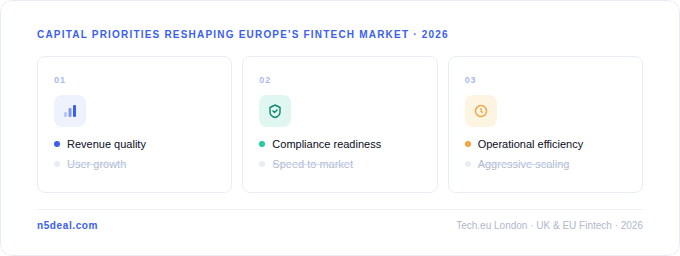
Across the European fintech market, the narrative has changed. Growth is still important — but it is no longer enough. Investors at the event repeatedly emphasized three priorities that are reshaping how capital is deployed: revenue quality over user growth, compliance readiness over speed to market, and operational efficiency over aggressive scaling. This reflects broader UK EU fintech trends, where capital is flowing toward companies that demonstrate resilience, not just ambition. For founders, this means storytelling alone is no longer sufficient — metrics, governance, and execution now carry equal weight.
Infrastructure Is Back in Focus
One of the most notable shifts in fintech investment Europe is the renewed interest in infrastructure players — payments processors, BaaS platforms, compliance tooling, and ledger systems. In the current cycle, these businesses are seen as more defensible and scalable compared to pure consumer apps. Infrastructure benefits from recurring revenue models, embeds deeply into client operations, and is significantly harder to replace once adopted. This is driving a quiet but important reallocation of capital toward enabling layers rather than front-end experiences.
The Regulatory Advantage in Europe
Regulation, once seen as a barrier, is becoming a strategic asset. Discussions at the event around EU fintech regulation highlighted how frameworks like PSD2, MiCA, and e-money licensing regimes are creating clearer operating environments. For many participants, this regulatory clarity is now a competitive advantage of the European fintech market compared to less predictable jurisdictions. Compliance expectations are rising alongside that clarity — founders must design products with regulation embedded from day one, particularly for cross-border expansion where alignment across EU markets is improving but not yet complete.
UK Fintech: Still a Global Leader
Despite macroeconomic pressures, UK fintech innovation remains a central pillar of the ecosystem. London continues to attract talent, capital, and global partnerships. Strong positioning in embedded finance and payments, continued leadership in fintech infrastructure, and an increasing focus on international expansion beyond Europe all featured prominently in event discussions. The UK's ability to combine regulatory expertise with product innovation keeps it at the forefront of the broader regional landscape.
Investment Sentiment: Cautious but Active
The mood around fintech investment Europe is best described as selective optimism. Investors are still deploying capital, but with stricter criteria: clear paths to profitability, proven unit economics, and defensible market positioning. Late-stage funding remains more constrained, while early-stage deals are picking up — especially for infrastructure and AI-driven models. This reflects a broader recalibration where quality is consistently outperforming quantity.
What Signals Actually Matter
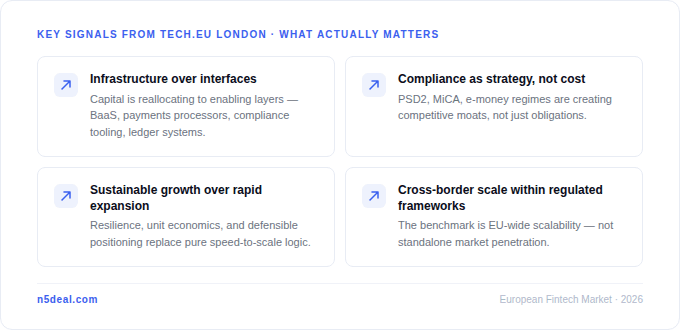
For founders and investors, the key signals emerging from Tech.eu London fintech are not about headlines — they are about direction. Infrastructure is being prioritized over interfaces. Compliance is treated as strategy, not cost. Sustainable growth is valued over rapid expansion. Cross-border scalability within regulated frameworks is the benchmark, not standalone market penetration. These signals are actively shaping how companies are built, funded, and acquired across Europe in 2026.
Conclusion
The event reinforces a clear message: the European fintech market is maturing. The era of easy capital and unchecked growth is over, replaced by a more disciplined, infrastructure-driven market. UK EU fintech trends in this cycle will favor the most resilient and well-structured players — not simply the fastest movers.
Disclaimer:
This article is for informational purposes only and does not constitute legal, financial, or investment advice. Market conditions and regulatory frameworks vary, and readers should consult qualified professionals before making strategic decisions.
Comments
Frequently Asked Questions
Clear, concise info to help you understand the process!