

The strongest European fintech M&A signals point to selective consolidation, not broad market exuberance. Across London Warsaw Barcelona fintech ecosystems, buyers are prioritizing regulated infrastructure, distribution, and profitability. Fintech M&A trends Europe show that cross-border logic is getting stronger, even while local execution remains critical. Current European fintech deal activity favors assets with real revenue quality and compliance maturity. In 2026, market sentiment is improving — but only for companies that can demonstrate resilience and strategic fit.
Why One Week Across Three Cities Matters
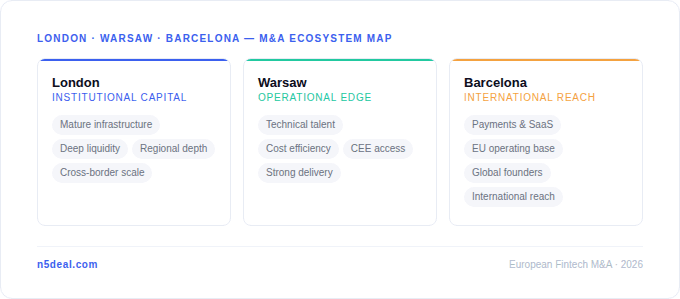
Looking at London, Warsaw, and Barcelona together offers a useful snapshot of where Europe is heading. These are different fintech ecosystems with different strengths, but when similar themes appear across all three, they become meaningful signals worth paying attention to.
London reflects institutional capital and mature fintech infrastructure. Warsaw highlights operational efficiency, technical talent, and regional scaling logic. Barcelona brings a mix of payments, SaaS, and international founder activity. Together, the London Warsaw Barcelona fintech picture shows where buyers are leaning — and what founders should prepare for.
Signal 1: Buyers Still Want Fintech — But Only theRight Kind
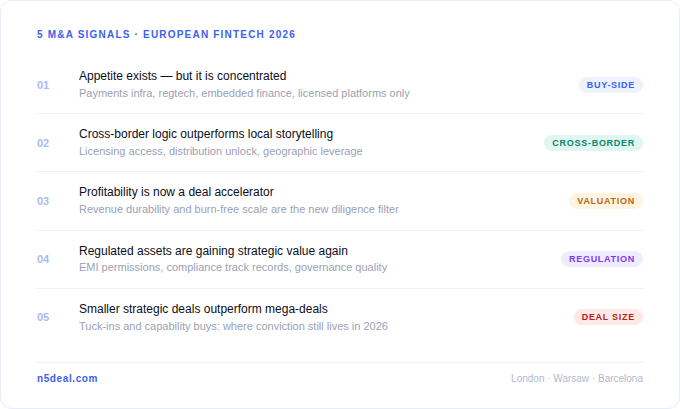
Appetite exists, but it is concentrated. In all three markets, investors and acquirers are focused on payments infrastructure, compliance and regtech tools, embedded finance enablers, and licensed or hard-to-replicate operating platforms. This fits broader fintech M&A trends Europe, where generic growth stories have lost persuasive power. Buyers want assets they can integrate, defend, and scale — which makes quality far more important than category alone.
Signal 2: Cross-Border Logic Is Stronger Than Local Storytelling
Cross-border fintech M&A is becoming more rational and more frequent. Buyers are increasingly evaluating targets based on whether they can unlock geographic expansion, licensing access, or customer segments beyond their home market. London buyers look for regional infrastructure depth. Warsaw-linked assets often bring cost-efficient delivery and strong technical teams. Barcelona-based firms can offer international reach and EU operating relevance. Borders still matter — but cross-border buyers are becoming more disciplined in how they price and integrate those opportunities.
Signal 3: Profitability Is Now a Deal Accelerator
Profitability — or at least near-term visibility to it — has become a decisive advantage in any sale process. In previous cycles, growth could compensate for weak margins. In 2026, that trade-off is much harder to make. Across European fintech deal activity, buyers are asking how durable the revenue is, how concentrated the client base is, how expensive compliance has become, and whether the platform can scale without disproportionate burn. Founders who can answer these questions clearly attract serious interest; those who cannot find themselves in longer, harder processes.
Signal 4: Regulated Assets Are Gaining Strategic Value Again
Licenses alone do not create premium value, but well-run regulated businesses are becoming meaningfully more attractive — and that pattern is visible across fintech M&A trends Europe. Buyers are paying closer attention to EMI and payment permissions, compliance track records, sponsor bank and scheme relationships, and the quality of internal governance and controls. Regulation is no longer treated as a box-ticking exercise. In many cases, it is part of the moat, which is why some of the clearest European fintech M&A signals are emerging from targets that combine regulated status with operational discipline.
Signal 5: Smaller Strategic Deals May Outperform Mega-Deals
The healthiest European fintech deal activity is increasingly happening below the headline-grabbing level. Instead of blockbuster acquisitions, the market favors tuck-in acquisitions, capability buys, product-extension deals, and distressed but salvageable assets with clear strategic fit. This is one of the most practical fintech market signals 2026 for founders and advisors: smaller deals are not a sign of weakness. In many cases, they are where conviction still lives, and where execution certainty is highest.
Conclusion
Taken together, these five signals suggest that Europe's fintech market is not frozen — it is maturing. London, Warsaw, and Barcelona each show different versions of the same message: buyers remain active, but only where strategy, resilience, and integration logic are clear. The next wave of deals will reward substance over story, and structure over hype.
Disclaimer:
This article is for informational purposes only and does not constitute legal, financial, investment, or transaction advice. Market conditions and deal structures vary by jurisdiction and company profile. Readers should consult qualified legal, tax, and M&A professionals before making strategic decisions.
Comments
Frequently Asked Questions
Clear, concise info to help you understand the process!